






Una controversia sobre el Método Madre Canguro es cuándo comenzar y quién es elegible, especialmente en el caso de los bebés en unidades de cuidados intensivos.
De acuerdo con el modelo de Rey y Martínez, descrito en las pautas de la OMS,[1] el bebé debe estar estable para "tolerar el contacto piel con piel".[2] [3] Sin embargo, cada hospital tiene una definición diferente de "estabilidad". Algunos consideran inestable a un bebé que está intubado. Algunos hospitales tienen la política de separar a los bebés de sus madres hasta que alcancen cierta edad gestacional, ciertos días después del nacimiento o un peso específico. Otros se toman el tiempo para implementar sistemáticamente el método madre canguro, mitigando los riesgos hasta el punto en que consideran que un bebé en oscilador está estable para recibir cuidado canguro.
Desde una perspectiva biológica y de neurociencia, otros argumentan que es la separación de la madre lo que causa la inestabilidad.[4],[5],[6]
El Dr. Bergman sugiere que en lugar de preguntar "¿cómo está tolerando el bebé el método madre canguro?", deberíamos preguntar: "¿cómo está tolerando el bebé no estar en el método madre canguro?".
El artículo "¿Deberían los neonatos dormir solos?" fue publicado en Biological Psychiatry en noviembre de 2011.
Comenta a continuación: ¿cuál es tu opinión, tu experiencia o la política de tu hospital?
Referencia:
[1] OMS. Cuidado madre canguro - guía práctica. Ginebra, Suiza: OMS; 2003.
[2] Charpak N, Ruiz-Pelaez JG, Figueroa dC. Current knowledge of Kangaroo Mother Intervention. Curr Opin Pediatr 1996 April;8(2):108-12
[3]Charpak N, de Calume ZF, Ruiz JG. "The Bogota Declaration on Kangaroo Mother Care": conclusions at the second international workshop on the method. Second International Workshop of Kangaroo Mother Care. Acta Paediatr 2000 September;89(9):1137-40.
[4] Bergman NJ, Linley LL, Fawcus SR. Randomized controlled trial of skin-to-skin contact from birth versus conventional incubator for physiological stabilization in 1200- to 2199-gram newborns. Acta Paediatr 2004 June;93(6):779-85
[5] Bergman N. The neuroscience of birth - and the case for zero separation. Curationis 2014;37(2):1-4
[6] Phillips R. The Sacred Hour: Uninterrupted Skin-to-Skin Contact Immediately After Birth. Newborn and Infant Nursing Reviews 2013;13(2):67-72.
2 comentarios
As a nurse in a neonatal intensive care unit who is very much in favour of skin to skin I do sometime s ask myself if I sometimes am going to far. For example a very stable 24 weeker weight 740grams. On day four remains ventilated but doing very well and may even come off it soon, and onto cpap. Is day four too early to come out. Although very stable I often wonder about the other systems such as the blood pressure (all well on this baby). But they are not very good at auto regulating them selves and how does their vestibular system cope should I take this day 4, 24 weeker out for skin to skin?
Thank you
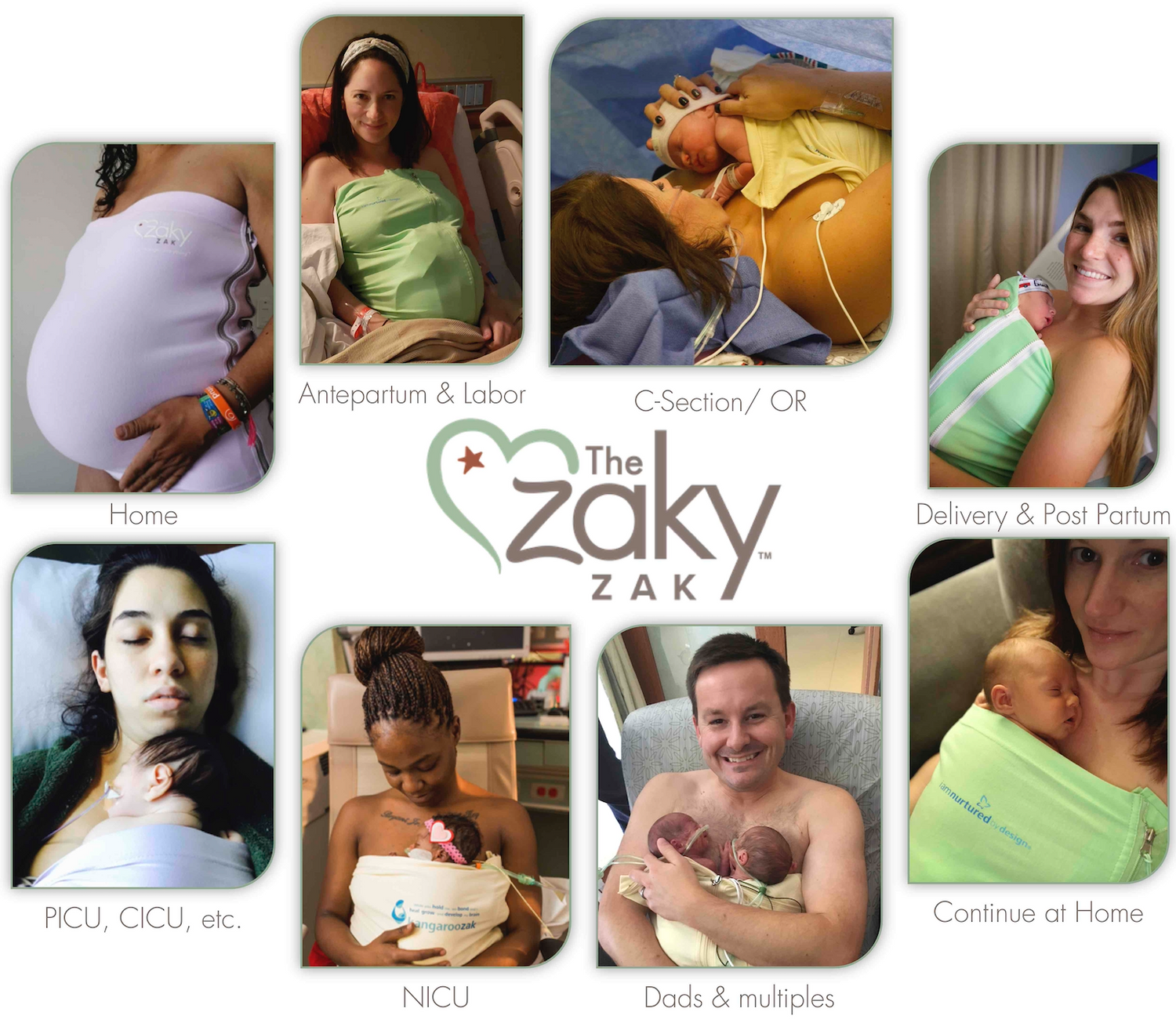
My son was born weighing 906 grams and I kangarooed within 24 hours. It was good for him and for me, and I truly believe it did wonders for our relationship. There was nothing else I needed most than to show him that he was not alone and that I loved him. With tools like The Zaky ZAK, babies can be secured and positioned midline on the mom/dad, and foster their relationship and no-separation while providing the best possible care.